Integrating Generative AI into Your CMS: Smarter Content, Faster Workflows
Content is at the heart of every modern digital business. Whether you're publishing blog posts, managing product catalogues, creating marketing campaigns or maintaining a company website, your Content Management System (CMS) is where much of that work begins.
As Generative Artificial Intelligence (AI) continues to mature, organisations are discovering that AI can do far more than simply generate text. When integrated directly into a CMS, it can streamline workflows, improve content quality, personalise user experiences and significantly reduce the time it takes to publish new content.
Research such as McKinsey's State of AI shows that organisations are increasingly embedding AI into everyday business workflows rather than treating it as a standalone tool.
Rather than replacing content creators, Generative AI works alongside them, handling repetitive tasks while allowing writers, editors and marketers to focus on creativity, strategy and quality.
Why Integrate Generative AI with Your CMS?
Adding AI capabilities to your CMS isn't simply about introducing another tool, it's about improving the entire content creation process.
Whether you're managing a corporate website, an e-commerce platform or a digital publishing operation, AI can accelerate many of the everyday tasks that slow teams down.
Faster Content Creation
One of the most immediate benefits is speed.
Generative AI can assist with creating:
Blog article drafts
Product descriptions
Marketing copy
Landing page content
Social media posts
Email campaigns
FAQs
Documentation
Instead of beginning with a blank page, content teams can start with a well-structured draft that can be reviewed, refined and approved.
This reduces production time while maintaining human oversight.
Research from Harvard Business School and Boston Consulting Group found that professionals using generative AI completed many knowledge-based tasks significantly faster while often improving the quality of their work.
Better Personalisation
Modern audiences increasingly expect personalised digital experiences.
By combining AI with customer data already stored within your CMS or connected platforms, content can be adapted to different users based on factors such as:
Location
Interests
Previous interactions
Purchase history
Industry
Device type
This allows businesses to deliver more relevant experiences without manually creating multiple versions of every page.
McKinsey's personalisation research highlights that effective personalisation can significantly improve customer engagement and revenue.
Improved SEO
Generative AI can also support search engine optimisation by helping content teams:
Generate keyword ideas
Create SEO-friendly titles
Write meta descriptions
Suggest internal links
Improve readability
Identify related content topics
While AI should not replace a comprehensive SEO strategy, it can significantly reduce the time required to optimise content before publication.
Google's guidance on AI-generated content and Search makes it clear that high-quality, helpful AI-assisted content is acceptable when it provides value to users.
Automating Repetitive Tasks
Many content operations involve repetitive work that offers little creative value.
AI can assist with:
Summarising long articles
Creating content variations
Translating content
Rewriting existing copy
Generating image descriptions
Producing metadata
Creating content briefs
Automating these activities allows teams to spend more time focusing on planning, storytelling and audience engagement.
Common Integration Approaches
There are several ways to introduce Generative AI into an existing CMS.
The right approach depends on your platform, technical requirements and long-term objectives.
API-Based Integration
For many organisations, direct API integration offers the greatest flexibility.
Most leading AI providers offer APIs that allow your CMS to communicate directly with their models.
For example, an editor might click a Generate Draft button inside the CMS, which sends a prompt containing information such as:
Topic
Target audience
Writing style
Keywords
Desired length
The AI then returns generated content directly into the editing interface.
This approach allows organisations to build AI functionality that fits naturally into existing editorial workflows.
CMS Plugins and Extensions
Many popular content management systems now offer AI plugins that simplify deployment.
These integrations often provide features such as:
AI-assisted writing
Content rewriting
Image generation
SEO optimisation
Translation
Grammar checking
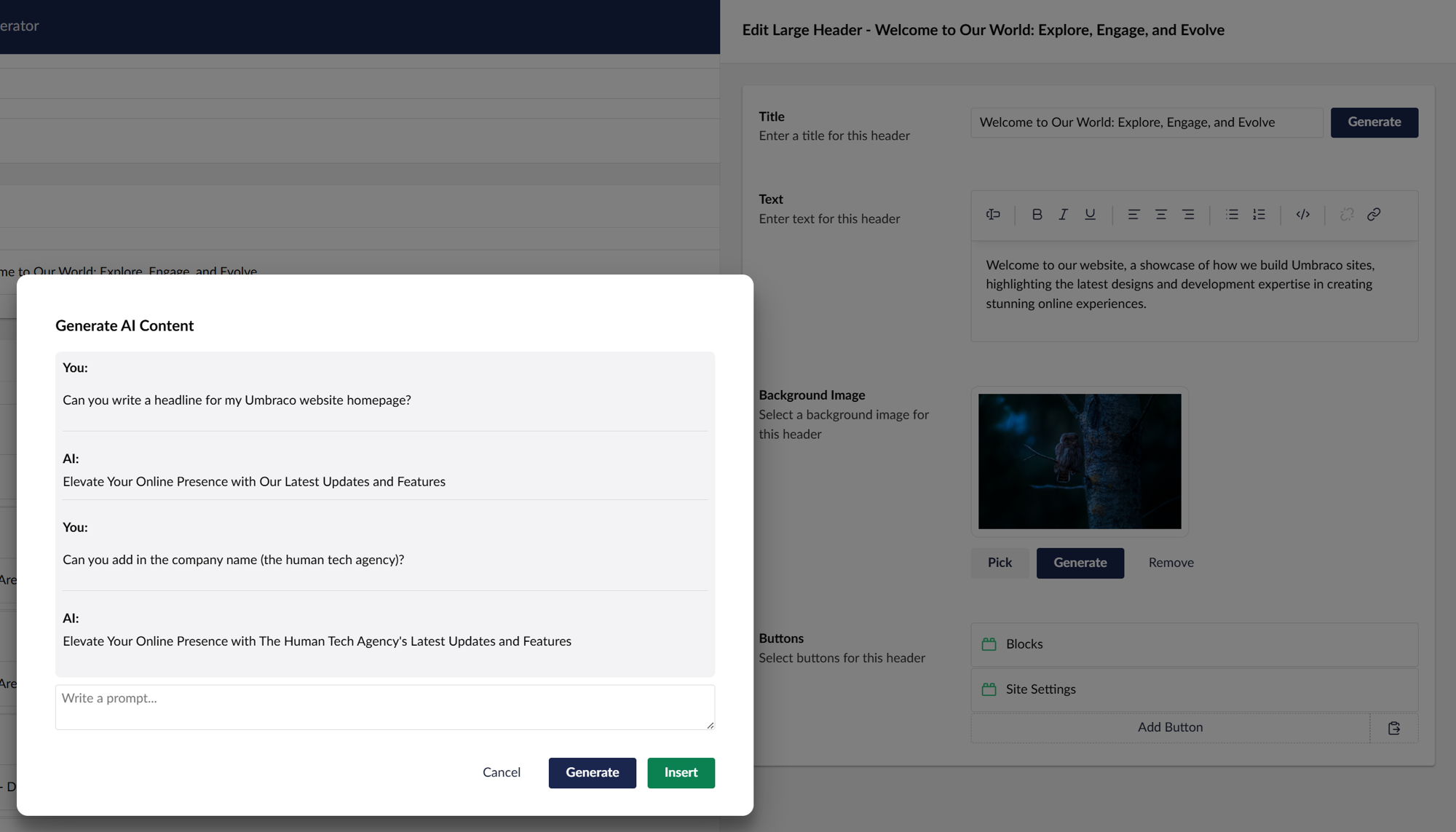
A practical example: AI inside Umbraco
For organisations using Umbraco CMS, AI can be integrated directly into the editing experience rather than requiring editors to switch between multiple tools.
For example, our Umbraco AI Extension enables editors to generate and improve content directly within the Umbraco backoffice. Features include AI-assisted content generation, rewriting existing copy, creating summaries, generating SEO metadata, and helping editors overcome writer's block, all without leaving the CMS.
Because the AI functionality is embedded into familiar editorial workflows, content teams can take advantage of generative AI while maintaining existing approval and publishing processes.
Headless CMS Integration
Businesses using headless CMS platforms are often particularly well positioned for AI adoption.
Because headless systems already communicate through APIs, AI services can be integrated into content workflows with relatively little disruption.
This allows AI-generated content to flow seamlessly across multiple digital channels, including:
Websites
Mobile applications
Customer portals
Digital signage
E-commerce platforms
The result is a more consistent and scalable content strategy.
Important Considerations Before You Begin
Successful AI integration requires more than connecting an API.
Several important technical and organisational factors should be considered.
Data privacy and security
Content often contains commercially sensitive information.
Before sending data to external AI providers, organisations should consider:
GDPR compliance
Client confidentiality
Data retention policies
Encryption
Access controls
Internal governance
The NIST AI Risk Management Framework provides useful guidance for organisations adopting AI responsibly.
Maintaining your brand voice
AI can generate impressive content, but it doesn't automatically understand your organisation's unique tone of voice.
Many businesses choose to:
Develop detailed prompting guidelines
Create reusable templates
Fine-tune models where appropriate
Establish editorial review processes
These measures help ensure AI-generated content remains consistent with brand standards.
Human review remains essential
Generative AI is capable of producing convincing but inaccurate information.
It may:
Misinterpret facts
Invent references
Misunderstand context
Produce outdated information
Editorial oversight remains critical.
The OpenAI Prompting Guide and the NIST AI RMF both reinforce that AI should augment human decision-making rather than replace it.
Preparing your content team
Introducing AI also requires cultural change.
Content teams benefit from training in areas such as:
Effective prompting
AI limitations
Fact-checking
Ethical AI usage
Quality assurance
Helping employees understand how AI supports rather than replaces their expertise often leads to stronger adoption.
The Business Benefits
When implemented effectively, AI integration can deliver measurable improvements across the organisation.
These often include:
Faster content production
Lower operational costs
Improved consistency
Greater content output
Better SEO performance
Enhanced customer engagement
Shorter publication cycles
More time for strategic work
Perhaps most importantly, AI allows organisations to scale content creation without increasing workload at the same rate.
This aligns closely with findings from McKinsey's State of AI and PwC's AI research, both of which identify productivity improvements as one of AI's primary business benefits.
Looking Ahead
Generative AI is rapidly becoming a standard feature within modern content management platforms.
As models continue to improve, we can expect AI to play an even greater role in:
Content planning
Editorial workflows
Personalisation
Accessibility
Multilingual publishing
Knowledge management
Rather than replacing creative professionals, AI will increasingly act as an intelligent assistant that helps teams work faster and make better decisions.
Conclusion
Integrating Generative AI into your CMS is about far more than generating content automatically. It is an opportunity to modernise the entire content lifecycle, improving efficiency while enabling teams to focus on creativity, strategy and delivering greater value to their audiences.
Whether through API integrations, CMS plugins or headless architectures, organisations now have a range of options for introducing AI into their existing platforms.
The businesses that gain the greatest advantage will not be those that publish the most AI-generated content, but those that successfully combine the speed and scalability of AI with the expertise, judgement and creativity of their people.
Used responsibly, Generative AI becomes more than a productivity tool, it becomes a powerful extension of your content team, helping you create smarter digital experiences for the future.